
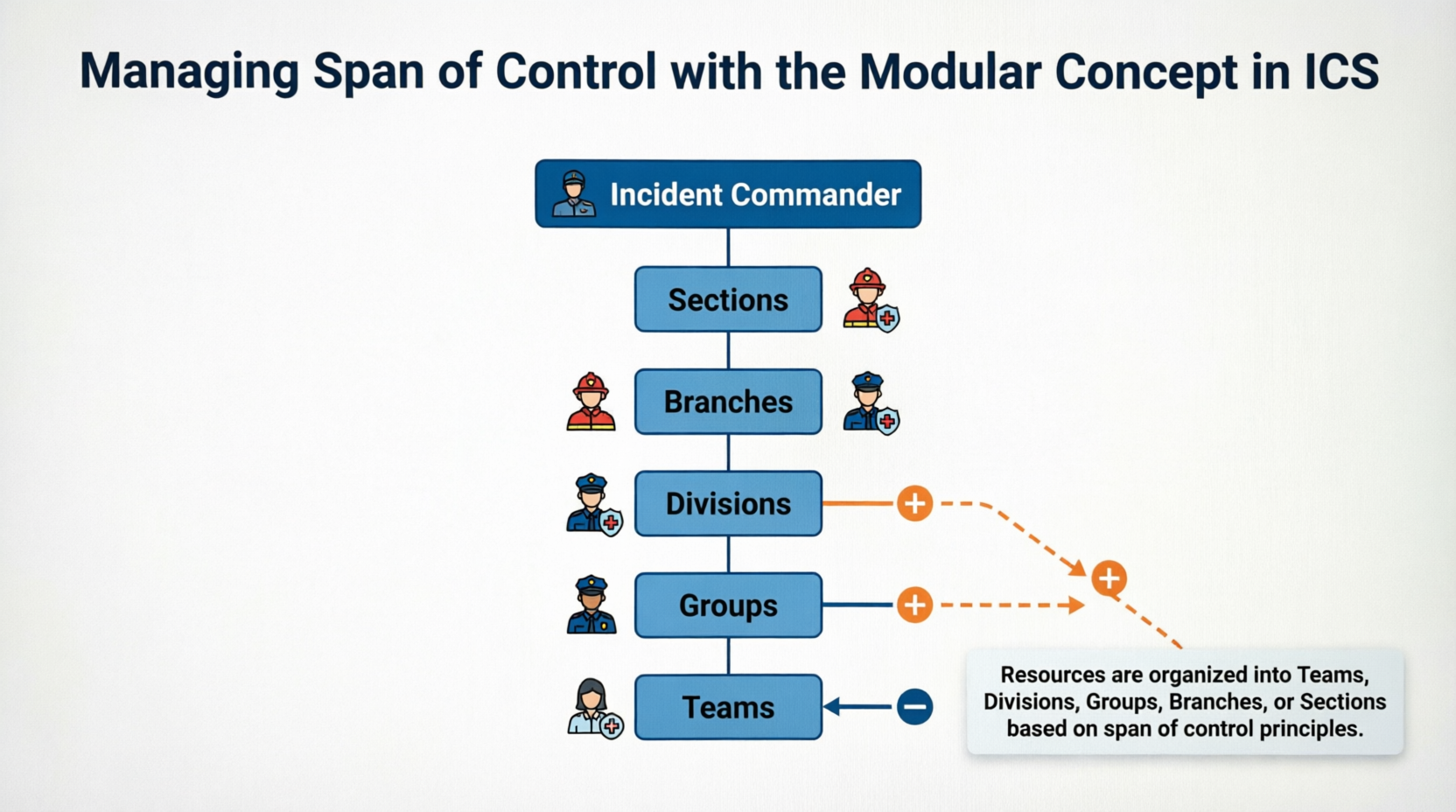
If you have ever prepared for an ICS certification exam or worked in emergency operations, you have likely faced the question: Which statement below correctly describes how to manage span of control using the modular concept? This single idea sits at the heart of effective incident management. It is not just theory from a textbook. It is the practical framework that keeps supervisors from becoming overwhelmed while ensuring every responder stays safe and accountable during wildfires, floods, hazardous material spills, or large public events.
When you ask which statement below correctly describes how to manage span of control using the modular concept, the answer points directly to the Incident Command System’s flexible, scalable nature. The modular concept lets leaders build or shrink the organization exactly as the incident demands. Instead of forcing one person to supervise too many people or leaving supervisors idle with too few, the structure adapts in real time. That adaptability is what separates chaotic responses from coordinated ones.
Understanding this principle helps both new responders and seasoned commanders. It reduces errors, speeds decision-making, and protects lives. In the sections that follow, we will unpack every part of the concept, show you the correct statement in context, explore supporting tools like teams and branches, and give you practical ways to apply it today.
Understanding Span of Control in Modern Incident Management
Span of control simply means the number of people or units one supervisor can effectively oversee. In the high-stakes world of emergency response, that number usually falls between three and seven subordinates. The sweet spot most experts recommend is five. When a supervisor exceeds that range, communication breaks down, safety checks get missed, and fatigue sets in fast. When the number drops too low, resources sit idle, and the organization wastes time and money.
Factors that influence the right span include the complexity of tasks, the distance between teams, the experience level of personnel, and how quickly conditions change. A calm traffic accident might allow a wider span. A fast-moving wildfire with changing winds demands a tighter one. The key is recognizing when the current ratio no longer works and adjusting before problems grow.
An effective span of control also builds trust. Subordinates know their supervisor has the bandwidth to listen, coach, and step in when needed. Supervisors stay sharp because they are not drowning in details. This balance becomes even more important when multiple agencies work together under unified command.
What Exactly Is the Modular Concept in ICS and NIMS?
The modular concept is the built-in flexibility of the Incident Command System. It follows a simple “form follows function” rule. You activate only the parts of the organization that the incident actually needs. You never build a giant structure just because the manual says so. As the situation grows or shrinks, you add or remove layers without rewriting the entire plan.
This approach starts at the top with the Incident Commander. If the commander can handle everything alone, the organization stays small. The moment the workload or the number of resources exceeds what one person can manage, the commander activates sections, branches, or other units. The same logic flows downward. Every leader uses the same expandable model.
Because the structure is modular, it naturally supports changes in span-of-control needs. You do not have to wait for a new incident action plan to reorganize. You adjust on the fly during planning meetings or even between operational periods. That speed and simplicity save precious minutes when minutes matter most.
Answering Which Statement Below Correctly Describes How to Manage Span of Control Using the Modular Concept
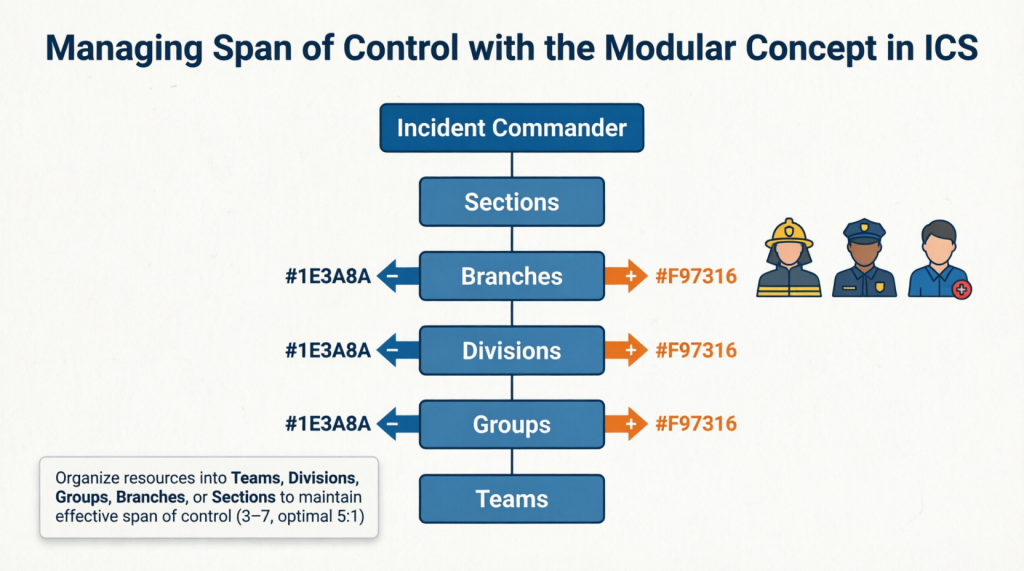
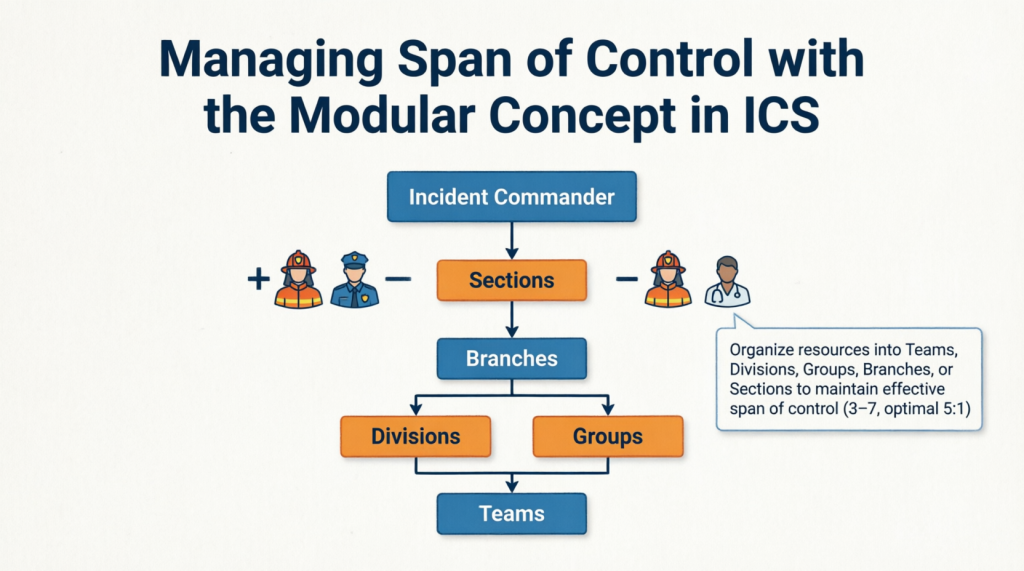
If you are studying and wondering which statement below correctly describes how to manage span of control using the modular concept, here is the clear answer. The correct description states that span of control is accomplished by organizing resources into teams, divisions, groups, branches, or sections. When the ratio becomes unmanageable, you create additional units. When it becomes too loose, you consolidate or demobilize units to restore balance.
Many test questions offer tempting but incomplete options. Some mention safety factors or task types alone. Others suggest fixed ratios that never change. Only the statement that ties modular organization directly to span-of-control management captures the full picture taught in official NIMS and ICS materials.
When you see which statement below correctly describes how to manage span of control using the modular concept on an exam, look for language about expanding or contracting the organization through these specific building blocks. That phrasing matches the official guidance almost word for word and earns full credit.
Key Organizational Elements That Help Maintain Effective Span of Control
Several building blocks make the modular concept work in practice. Teams sit at the lowest level and usually handle one specific task with a handful of people. Divisions organize resources by geography, such as dividing a river flood into north and south sectors. Groups are organized by function, like all search-and-rescue teams reporting to one group supervisor.
When even those units grow too numerous for a section chief to oversee, branches come into play. A branch director manages several divisions or groups, keeping the span of the operations section chief’s span reasonable. At the highest level, sections such as Operations, Planning, Logistics, and Finance/Administration allow the incident commander to delegate major functions entirely.
Each element exists for one reason: to protect a manageable span of control. You activate them only when needed and deactivate them the moment they are no longer useful. This discipline keeps the organization lean and focused.
| Teams | Handle single tasks with small groups | Specific job requires dedicated resources | Hose team assigned to structure protection |
| Divisions | Split work by physical location | Geographic spread exceeds supervisor reach | Division Alpha covers the east flank |
| Groups | Organize by function or kind | Similar skills needed across areas | Search group covers multiple neighborhoods |
| Branches | Group multiple divisions or groups | Section chief span exceeds 5-7 units | Operations Branch for heavy equipment |
| Sections | Major functional management | Incident commander span becomes unmanageable | Full Operations Section activated |
Benefits of Applying the Modular Concept During Real Incidents
Using the modular concept to manage span of control delivers immediate, visible wins. First, safety improves because every supervisor actually has time to check on people and conditions. Second, decision speed increases. Information does not have to travel through too many layers before reaching someone who can act. Third, accountability strengthens. Everyone knows exactly who they report to and what their piece of the mission involves.
Resource efficiency also rises. You avoid over-staffing the command post with unnecessary positions. At the same time, you never leave critical functions under-supervised. The organization grows and shrinks with the incident, matching resources to needs instead of forcing needs to fit a rigid chart.
Agencies that train this way report smoother transitions between operational periods. Handovers become routine because the structure itself stays consistent even as the size changes. That consistency reduces confusion for mutual-aid partners who may arrive mid-incident.
Common Challenges and How the Modular Approach Solves Them
One frequent mistake is letting the span of control drift too wide before anyone notices. A busy operations section chief might keep adding resources without creating branches. Fatigue and missed details soon follow. The modular concept solves this by making expansion the expected, normal step rather than an emergency fix.
Another challenge appears when the incident shrinks. Leaders sometimes keep extra layers in place out of habit. The modular concept encourages timely demobilization. You simply collapse units back into the next higher level, freeing people to go home or support other missions.
Communication overload is a third common issue. When too many people report to one supervisor, radio traffic becomes constant, and important messages get lost. By inserting divisions or groups, you create natural points for filtering. Only essential information climbs the chain, while routine coordination happens at lower levels.
Best Practices Every Incident Commander Should Follow
Start every incident by asking whether your current span feels manageable. If you are the incident commander and already juggling operations, planning, logistics, and finance in your head, activate at least one section chief. Do not wait for a crisis.
During planning meetings, openly review the span-of-control numbers. Ask section chiefs how many direct reports they currently have and whether they need relief. Build those adjustments into the next operational period plan so that everyone can see the logic.
Train your team on the language of modular organization. When someone says “we need a branch here,” everyone understands it is a span-of-control move, not empire building. Use consistent position titles and clear delegation so new arrivals plug in quickly.
Finally, practice deactivation as seriously as activation. At the end of each operational period, look for units that can be safely folded back together. This habit keeps the organization healthy and prevents unnecessary overtime or resource hoarding.
Training and Certification Tips for Mastering This Concept
If you are preparing for ICS 100, 200, or higher courses, treat the modular concept and span of control as linked topics. Draw simple org charts on paper or a whiteboard. Start with a small incident and keep adding resources until you have to insert a new layer. Then shrink it back down. Muscle memory helps more than memorizing definitions.
Look for the exact phrasing in practice tests. Questions that ask which statement below correctly describes how to manage span of control using the modular concept almost always reward answers that mention organizing into teams, divisions, groups, branches, or sections. Wrong answers usually focus on one factor in isolation or suggest rigid ratios that never flex.
Join exercises whenever possible. Real incidents or full-scale drills reveal nuances that classroom slides miss. You will feel the moment a supervisor’s span tips from comfortable to chaotic, and you will see how quickly adding one branch restores order.
Real-Life Lessons from Past Emergency Responses
During large-scale wildfire seasons, incident management teams routinely use the modular concept to maintain a healthy span of control across hundreds of resources. When the fire grows, they stand up geographic branches so division supervisors are not stretched across too many miles. When containment lines hold and resources demobilize, they collapse branches back into divisions within hours.
Hurricane responses show the same pattern. Initial incident commanders often manage with a small team. As shelters open, power restoration begins, and debris removal scales up, they activate full sections and branches. The structure expands without chaos because everyone already knows the modular playbook.
These examples prove the concept works at every scale. Whether you are managing a neighborhood flash flood or a multi-state disaster, the same rules apply: watch your span, use the building blocks, and let the organization breathe with the incident.
Conclusion
The question of which statement below correctly describes how to manage span of control using the modular concept has a straightforward yet powerful answer. You manage span of control by organizing resources into teams, divisions, groups, branches, or sections and by expanding or contracting those units as conditions change. This modular approach keeps supervisors effective, responders safe, and the entire operation focused on the mission.
Mastering this idea does more than help you pass a test. It makes you a better leader in any high-pressure environment. Start applying it in your next exercise or shift. Notice when your own span feels right and when it does not. Adjust early, communicate clearly, and watch how much smoother the response becomes. Effective incident management is not about having the biggest chart on the wall. It is about having the right chart for right now.
Frequently Asked Questions
What is the main goal of using the modular concept in incident command?
The main goal is to keep every supervisor’s span of control within effective limits while matching the organization’s size and shape to the incident’s actual needs. By adding or removing layers only when necessary, leaders avoid both overload and waste.
How does the span of control affect responder safety during an incident?
When the span of control grows too wide, supervisors cannot adequately monitor conditions, provide guidance, or catch hazards in time. The modular concept prevents this by letting leaders create new divisions or branches before safety margins shrink. Proper span keeps accountability tight and communication clear.
Which statement below correctly describes how to manage span of control using the modular concept on most ICS exams?
The statement that correctly describes it explains that span of control is accomplished by organizing resources into teams, divisions, groups, branches, or sections. When the ratio exceeds guidelines, additional units are established. When it falls too low, units are reorganized or demobilized. This matches official NIMS guidance exactly.
Can the modular concept be used in small, everyday incidents as well as major disasters?
Absolutely. Even a single-vehicle accident can benefit from modular thinking. If the incident commander realizes two engines and a rescue squad already exceed the comfortable span, they can quickly form a small task force or group. The same logic scales down just as easily as it scales up.
What happens if an incident commander ignores span of control guidelines?
Ignoring the limits often leads to missed radio traffic, delayed decisions, and increased risk to personnel. The modular concept exists precisely to give commanders an easy, built-in way to regain control before those problems appear. Using it early prevents small issues from becoming major complications.